
Our 2025–2026 Annual Report: from planning to action for amphibians
Wild-born rocket frogs in Panama, a national KBA assessment funded, and an alliance now 92 partners strong. Read the year in full.
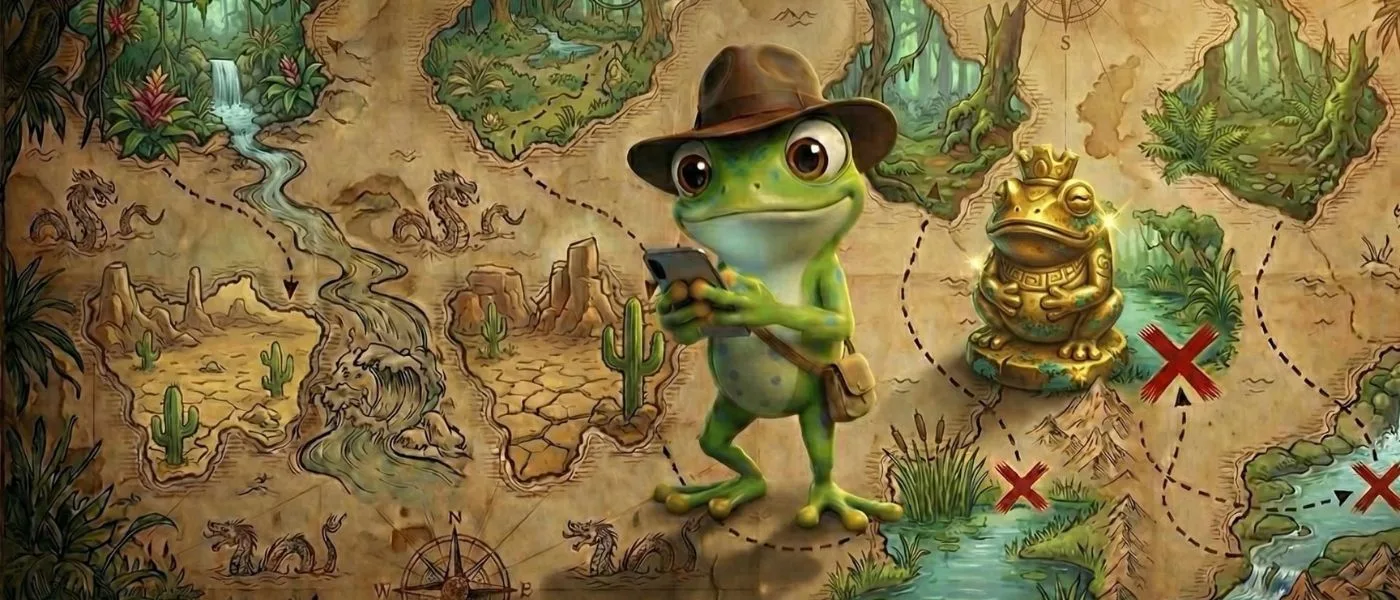
Remember when we said we'd been building "something special for the next generation of amphibian advocates"?
Meet The Ribbit Report.
It's a free educational app for young explorers aged 9–12, and it's the first time we've built something designed entirely for the generation that will inherit this crisis. Real science. Real researchers. Real species. Wrapped in an experience that actually makes kids want to keep reading.
And their guide? A curious, slightly dramatic frog explorer named MarshMellow.
The Ribbit Report isn't a single article or a PDF. It's an entire world of amphibian content, designed for the way kids actually consume information today.
Dispatches are field reports from real conservation researchers working in the field right now, from Panama to Peru to Nepal. Each one tells the story of a species through the scientist working to protect it. Kids learn about IUCN status, habitat threats, and conservation strategies without ever feeling like they're being lectured.
Field Notes are MarshMellow's personal journal entries from the field. Part storytelling, part science, entirely his voice. Current entries include a desert rain frog whose defense mechanism is being adorable, a glass frog with nothing to hide, and a salamander that predates the dinosaurs.
Wild Decisions puts kids in the driver's seat with choose-your-own-adventure conservation scenarios. There's no single right answer, just trade-offs, consequences, and the kind of critical thinking real conservationists use every day.
Myth Busters takes the things kids think they know about amphibians ("toads give you warts") and walks them through why the truth is more interesting than the myth.
The Real Story digs into the comparisons kids are already curious about, starting with the classic: Frogs vs. Toads.
And a Glossary with 58+ terms, written for a 10-year-old, with pronunciations. Because "Batrachochytrium dendrobatidis" shouldn't be the reason a kid stops reading.
We didn't cut corners because the audience is young. If anything, we held ourselves to a higher standard.
Privacy is not negotiable. No accounts. No cookies. No tracking. No personal data collected, period. The Ribbit Report is fully COPPA compliant. In a world where most apps treat kids as data sources, this one doesn't even know who they are.
It works offline. Once loaded, the app caches content so kids can keep reading without a connection. On a bus. In a waiting room. At a field station with unreliable wifi. Sound familiar?
It works on phones. Because that's what kids have. Mobile-first design, fast loading, accessible text sizing, screen reader support, and dark mode, because sometimes you want to read about frogs under the covers at night.
It's beautiful. Every dispatch has regional color palettes reflecting the local environment. Animations are subtle and purposeful. MarshMellow appears in different poses depending on the context. We wanted kids to open this and think "this is for me," not "this is homework."
41% of amphibian species are threatened. The science is urgent. The policy conversations are complex. And the generation that will live with the consequences of today's decisions is already online, already curious, and almost entirely unreached by the conservation community.
The Ribbit Report is our answer to that gap. Not by dumbing down the science, but by meeting young people where they are with content that respects their intelligence and earns their attention.
Every dispatch features a real researcher. Every species has a real IUCN status. Every conservation scenario reflects real trade-offs. We're not simplifying the crisis. We're making it accessible.
The Ribbit Report launches with 10+ dispatches, 3 field notes, multiple Wild Decisions scenarios, and a growing library of content. New dispatches and field notes will be added regularly, and we have plans for species profiles, a conservation toolkit, printable classroom activities, and deeper connections between the Ribbit Report and conservationists and researchers around the world (as well as schools)!
MarshMellow has a lot more field notes to write.
Take a look: amphibians.app
Share it with a kid you know. Share it with a teacher. Share it with anyone who's ever asked "how do we get the next generation to care about this?"
This is how.
Wild-born rocket frogs in Panama, a national KBA assessment funded, and an alliance now 92 partners strong. Read the year in full.

AmphiBios Issue 3 follows amphibians through restored wetlands, classrooms, working landscapes, laboratories, and art spaces, bringing practical conservation, research, and community experience together in a web-first issue built to be found, shared, and used.

Two issues in, AmphiBios has reached over 10,100 readers and 85 contributors across all seven realms. Here is what the community built, and how to be part of Issue 3.